
Cyber-Physical Systems Are Reshaping Security — Are We Ready for What Comes Next?
12/14/2025
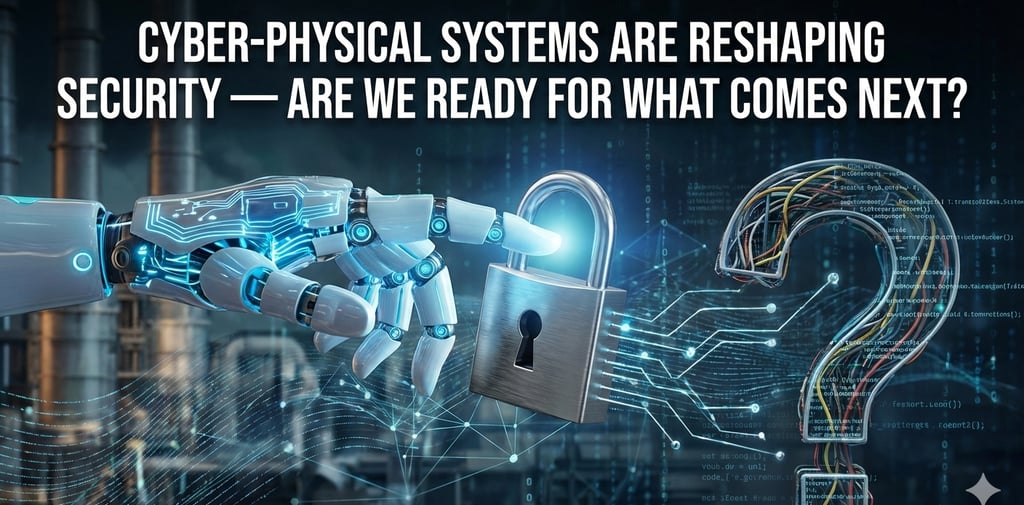
Cyber-Physical Systems Are Reshaping Security — Are We Ready for What Comes Next?
The convergence of digital and physical worlds is no longer a futuristic concept — it’s the operational reality of modern enterprises. From autonomous manufacturing lines to smart cities, cyber‑physical systems (CPS) are becoming the backbone of global infrastructure. Yet with this transformation comes a new class of risks that traditional cybersecurity models were never designed to handle.
As cybersecurity leaders, we’re standing at a crossroads. The systems we protect are no longer just servers and endpoints — they’re factories, hospitals, transportation grids, energy networks, and even entire economies. The stakes have never been higher.
In this article, I break down the latest insights and explore what they mean for CISOs, vCISOs, and security practitioners navigating this rapidly evolving landscape.
1. Cyber-Physical Systems: The New Frontier of Risk and Opportunity
CPS has evolved from simple PLC‑driven automation to intelligent, interconnected ecosystems powered by IoT, AI, machine learning, and edge computing. These systems now:
Sense and interpret real‑world conditions
Make autonomous decisions
Trigger physical actions in real time
Interact with humans, machines, and cloud services
This fusion of digital intelligence and physical capability unlocks enormous value — but it also creates unprecedented attack surfaces.
A compromise is no longer just a data breach.
It can mean physical disruption, safety hazards, environmental damage, or national‑level consequences.
2. Privacy Isn’t Dead — It’s Just Competing for Attention
One of the most striking themes in this issue is the quiet erosion of privacy as a board‑level priority. Ransomware, AI threats, and operational outages dominate executive conversations, pushing privacy concerns into the background.
But here’s the truth:
Privacy failures still cost organizations millions, damage trust, and trigger regulatory action.
CISOs must champion privacy even when it’s not fashionable. It’s not a compliance checkbox — it’s a core pillar of digital trust.
3. Biometrics: Trust Accelerator or Privacy Time Bomb?
Biometrics are becoming the default authentication method across industries. They offer:
Frictionless user experience
Stronger identity assurance
Competitive advantage for digital services
But they also introduce a chilling reality:
Passwords can be reset. Biometrics cannot.
Once compromised, biometric data becomes a permanent vulnerability. The OPM breach — where 5.6 million fingerprints were stolen — is a stark reminder of what’s at stake.
Organizations adopting biometrics must embrace:
Transparency
Minimal data collection
Encryption and secure storage
Clear opt‑out mechanisms
Rigorous auditing
Digital trust is earned, not assumed.
4. IT/OT Convergence: The Gap That Still Haunts Us
Despite years of warnings, the IT/OT divide remains one of the most persistent and dangerous gaps in cybersecurity.
OT environments often suffer from:
Legacy systems
Limited patching windows
Flat networks
Vendor‑controlled infrastructure
Safety‑over‑security culture
Meanwhile, IT teams bring modern security practices but lack OT context.
Bridging this gap requires:
Zero trust architectures
Network segmentation
Unified governance
Shared risk language
Cross‑functional training
Adoption of frameworks like NIST CSF and ISA/IEC 62443
CPS security is impossible without IT and OT speaking the same language.
5. Global Events: Cybersecurity on the World’s Biggest Stage
Major global events — Olympics, World Cup, G20 — are now prime targets for cyberattacks. Threat actors see them as high‑visibility opportunities to:
Disrupt operations
Spread misinformation
Undermine national reputation
Conduct espionage
Exploit massive digital infrastructure
Defending these events requires:
Early planning
Threat intelligence fusion
Red/blue/purple team exercises
Real‑time SOC coordination
Multi‑agency collaboration
These events are microcosms of the future: hyper‑connected, high‑stakes, and unforgiving.
6. Governance Challenges: CPS and the Sustainability Paradox
CPS promises efficiency and emissions reduction — but it also introduces environmental dilemmas:
Increased energy consumption
E‑waste
Water usage
Mineral extraction
Supply chain emissions
Governance must evolve to ensure CPS innovation aligns with sustainability goals. Security leaders have a role here too — resilience and sustainability are converging disciplines.
7. Case Studies: Real‑World Lessons We Can’t Ignore
The issue highlights several practical case studies:
✅ Remote auditing — now a permanent fixture, requiring new controls and communication models
✅ Automated packaging management — demonstrating how digital transformation reduces fraud and operational waste
✅ Mule account detection — showing how governance failures enable financial crime
✅ Risk appetite loopholes — revealing how blind spots in detection and asset visibility can cripple an organization
Each case reinforces a simple truth:
Cybersecurity is no longer just a technical discipline — it’s an organizational capability.
Final Thoughts: The Future Belongs to Those Who Adapt
Cyber‑physical systems are redefining the boundaries of cybersecurity. The organizations that thrive will be those that:
Embrace cross‑disciplinary thinking
Integrate privacy, security, and trust
Modernize governance
Invest in resilience
Prepare for AI‑driven threats
Build bridges between IT, OT, and business leadership
As cybersecurity professionals, we’re not just protecting systems anymore.
We’re safeguarding the infrastructure of modern civilization.
And that’s a responsibility worth rising to.